EV Charging Speed, Explained
Charging Speed Matters — and Here’s How It Works
When Speed Meets the Moment: Getting the fastest charge starts with understanding how your vehicle, battery and charger work together.
You pull in to a charging station, plug in your EV and glance at the screen to see how much time you have.
If you’re using Mercedes-Benz High-Power Charging, the answer is often about 20 minutes, or even 200 miles in 10 minutes for ultra fast charging vehicles1 like the Mercedes-Benz CLA. Enough time to step away, if you like, to grab a quick coffee or find a moment to breathe before getting back on the road.
That sense of timing changes how charging feels. It makes you realize that powering your EV doesn’t set the pace for your day. You do.
What is High-Power Charging?
We’re glad you asked. Not all charging is created equal.
You’ve probably seen Level 1, Level 2 and Level 3. Here’s what that means.
Level 1
Charging with a standard power outlet. Slow, but convenient if no other options are available.
Level 2
Common at homes, parking garages and workplaces. Best suited for longer stops, with most EVs charging in about four to 10 hours.
Level 3
DC fast charging. Built for highways, road trips and busy days. Designed to get you back on the road quickly.
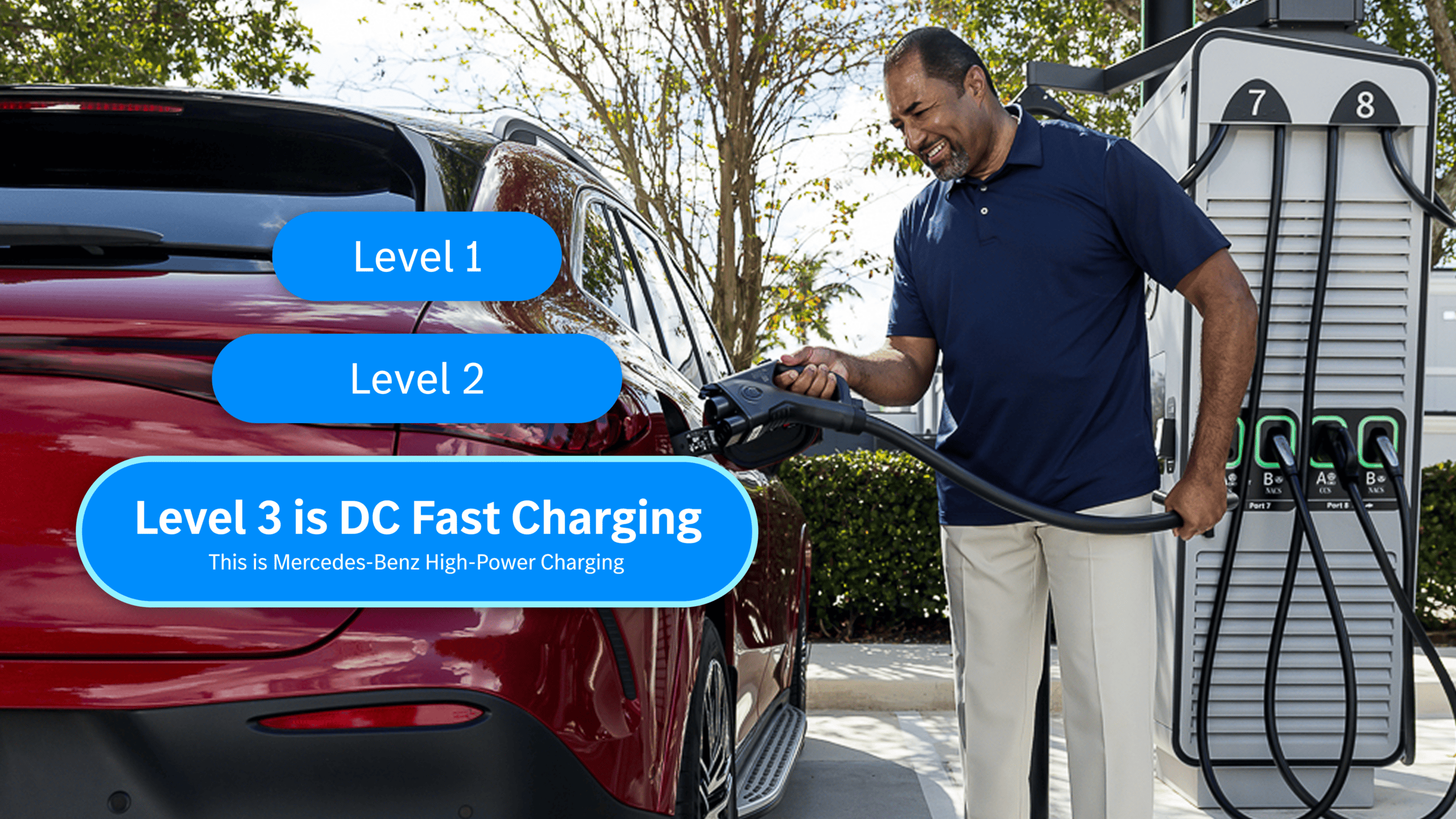
Each level is measured in kilowatts (kW). The higher the number, the faster the charge.
Some DC fast chargers deliver about 50kW. Others climb to 150kW or 250kW. Ours? Up to 400 kW1 — among the fastest publicly available charging in the United States and Canada.
Why Do Kilowatts Matter?
It helps to remember the difference between kW and kWh.
Kilowatts (kW): The rate at which power flows into your battery. Higher kW means faster charging.
Kilowatt hours (kWh): The total energy stored in your battery, similar to gallons in a fuel tank.
Kilowatts combine two things: voltage (V) and amperage (A).
Think of voltage like the pressure inside an espresso machine, while amperage is like how many shots it can pull at once. Together, they determine how quickly your cup (i.e., battery) fills. Kilowatt hours describe the size of the battery, like a small, medium or large cup.
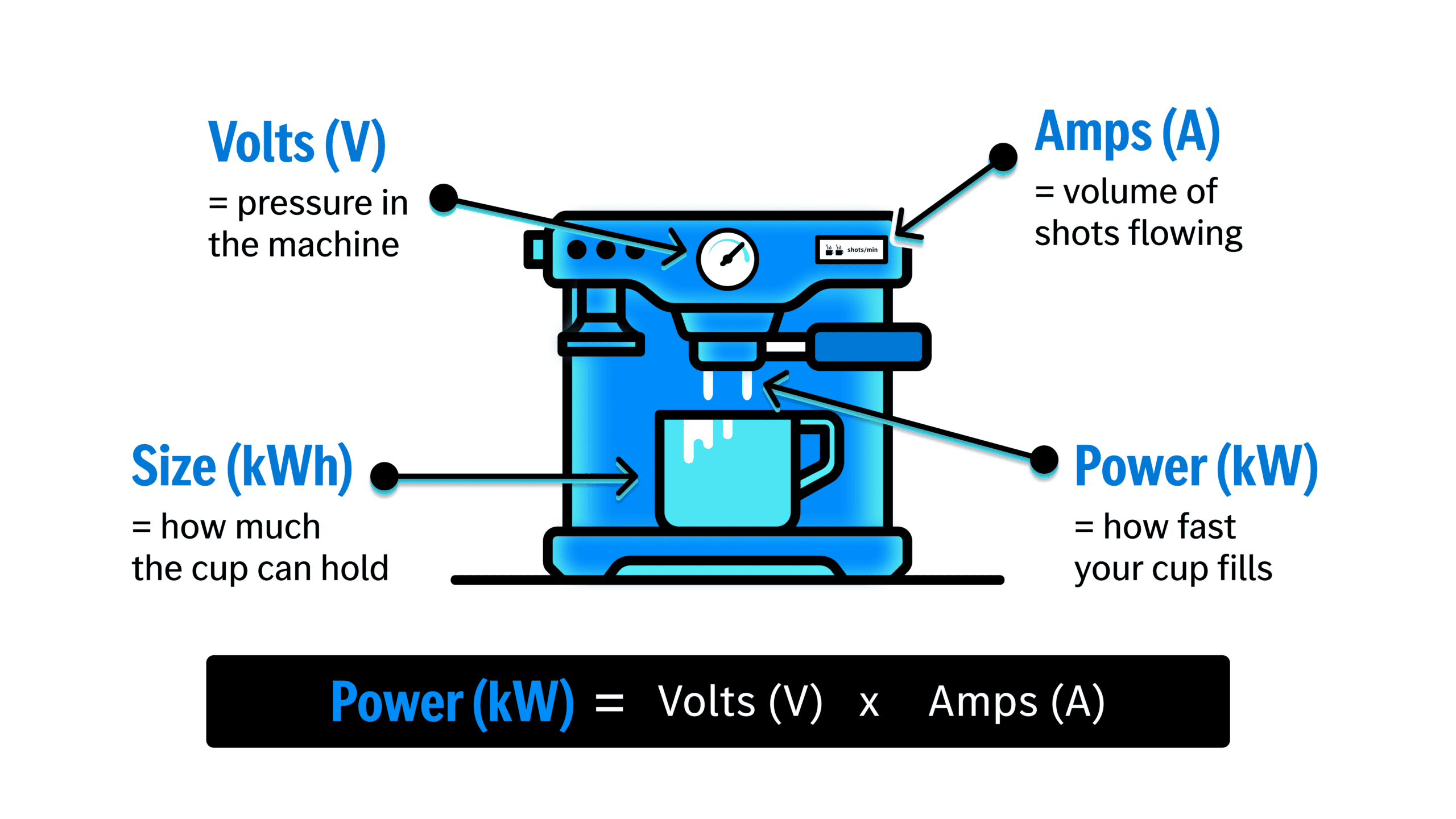
No matter how powerful the machine is, it won’t overfill your cup — it knows how much your cup can hold.
The same is true with Mercedes-Benz High-Power Charging. Your car draws the power it needs at the speed it can accept. The charger won’t overfill your cup.
Can My EV Get Too Much Charge?
No, your EV can’t get too much charge.
Battery longevity is one of the most common concerns for EV owners. Some drivers may assume fast charging puts extra strain on the battery. But modern EV batteries are designed to manage charging and optimize power delivery.
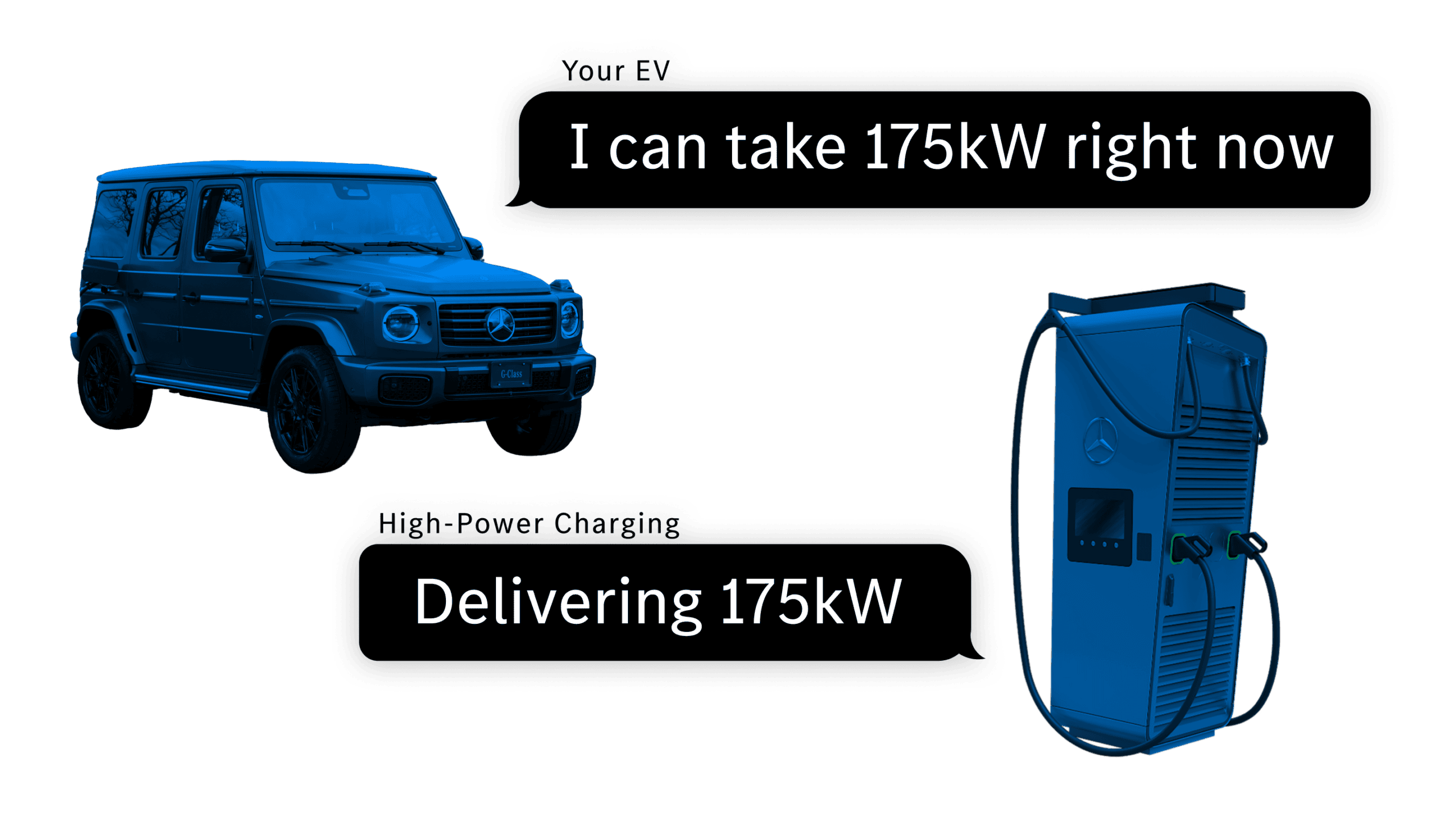
Your car tells the charger how much power it can safely accept. Then Mercedes-Benz High-Power Charging delivers that amount, up to 400kW.1
It’s like a handshake between the car and the charger.
Charging speeds vary throughout the session based on what your vehicle can accept at any given moment.
Why Do Different Cars Charge Differently?
Charging speed adjusts according to your vehicle and the conditions. Here are the factors that matter most.
- Battery Technology: Some vehicles’ charging speeds peak around 50kW. Others can request 200kW or more. Check your owner’s manual for your vehicle’s maximum charging speed.
- State of Charge: Your battery level also affects charging speed. Charging is generally faster when your state of charge is lower.
- Battery Temperature: Too hot, too cold or just right? Batteries charge best within a comfortable temperature range.
- Energy Use: Running cabin systems (such as heating or air conditioning), elevation and driving speed can affect charging speed.
Did you know?
EVs charge best when batteries are preconditioned to 68° to 77° F. Meanwhile, Mercedes-Benz High-Power Charging operates at full capacity across a range of outdoor temperatures from -22° to 131° F.
The charger plays a role, too. Mercedes-Benz High-Power Charging units can power multiple vehicles simultaneously. Power is automatically adjusted between vehicles based on what each one requests.
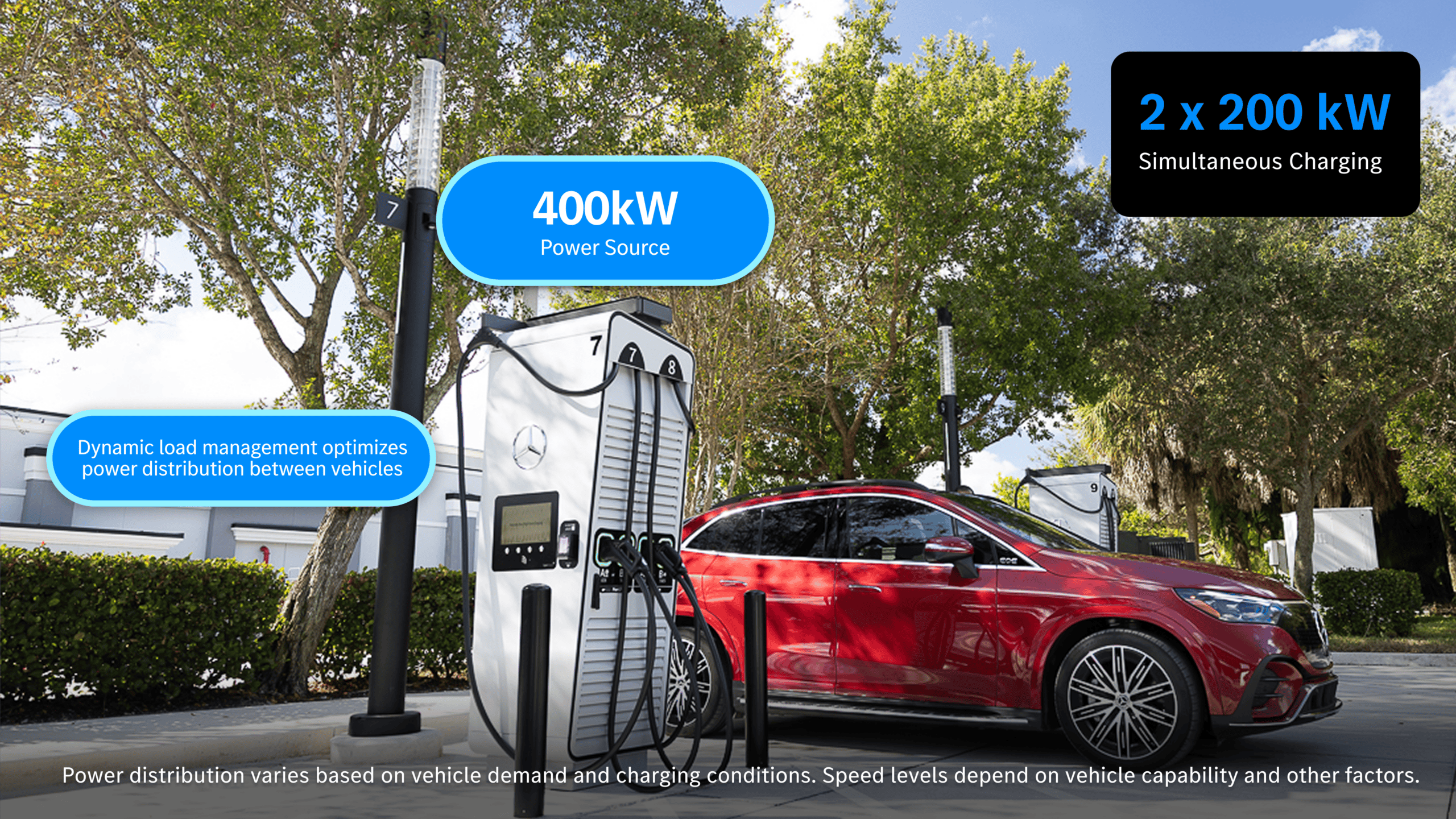
Even when power is shared, each stall can still deliver at least 200kW2.
Why Does My Speed Change While Charging?
Charging speed doesn’t stay constant. As your battery fills, it naturally begins to slow down — a pattern known as the charging curve. Most EVs charge fastest between lower and mid states of charge, then gradually taper as the battery fills.
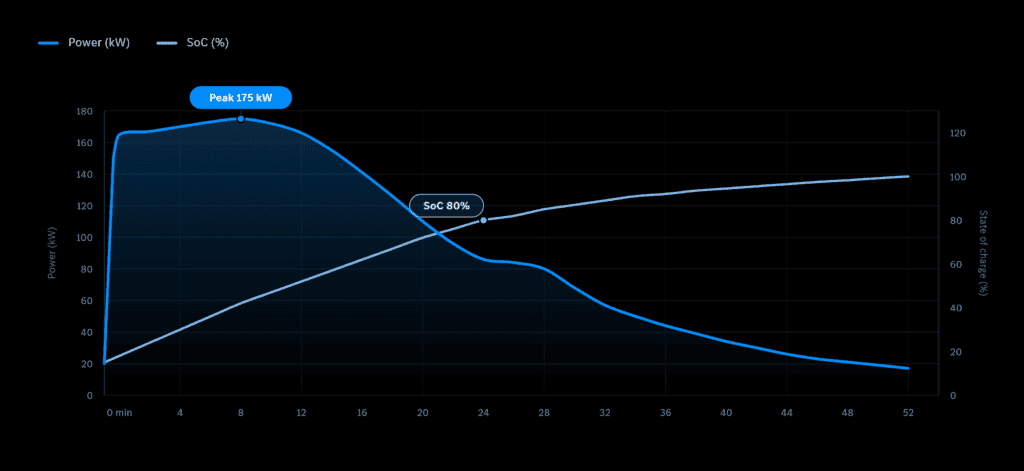
This is what the pattern looks like in real time.
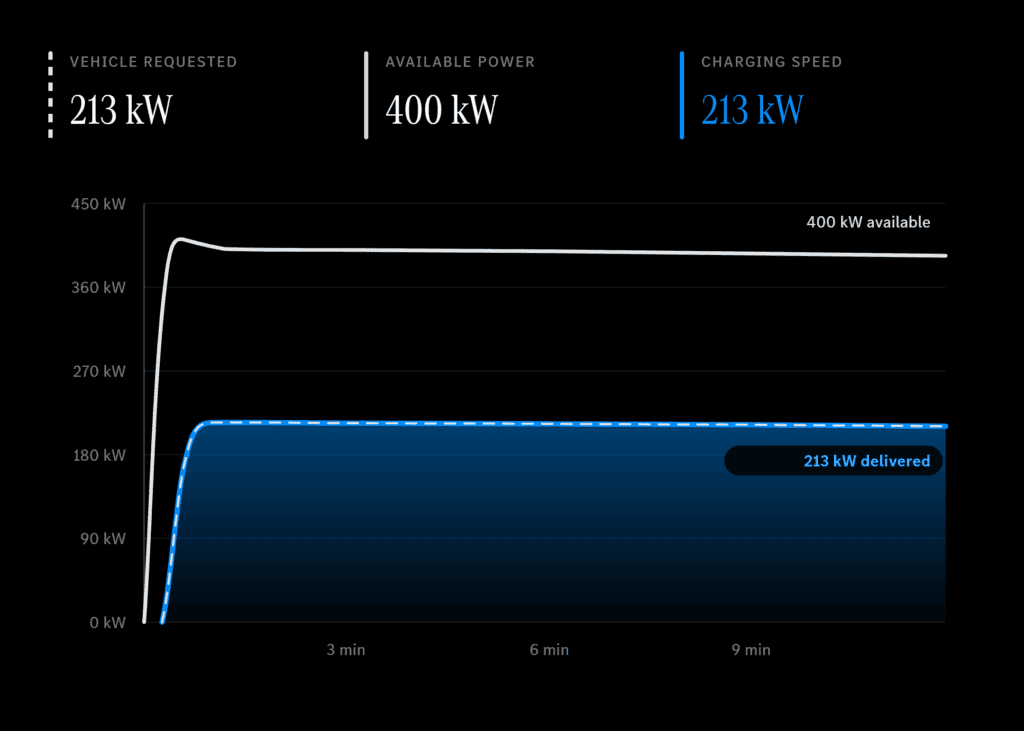
Across the Mercedes-Benz High-Power Charging network, you may see different screen layouts depending on the hardware in use, including Alpitronic HYC400 and ChargePoint Express Plus chargers.
Both types are designed to deliver high-speed charging up to 400kW,1 supported by high-voltage systems (up to 1000V and 600A) for consistent performance. Even when a site is full, each stall is designed to deliver at least 200kW if your car is able to accept it.
The charging curve is like a parking lot filling up before a big concert. Early on, you can roll in and park almost instantly. But as the lot fills, open spaces become harder to find. Drivers slow down, scanning for the few remaining spots.
Your battery behaves the same way. When it’s nearly empty, it can accept energy quickly. As it approaches 80%, the system becomes more deliberate, accepting power more gradually. The slowdown means your battery is doing exactly what it needs to do.
Get More From Your Charging Session
Scan the QR code on our charger screen to access your EV’s charging session in our Portal, a live, app-free way to track your charging session. See energy dispensed, what your vehicle requests versus what the charger delivers, your running cost, and more. Learn more
How Can I Get the Fastest Charge?
Now you know how charging speed works. But how can you ensure you’re reliably getting the fastest possible charge?
Battery temperature plays a major role in how quickly you charge. You can save time by preconditioning your battery before you arrive.
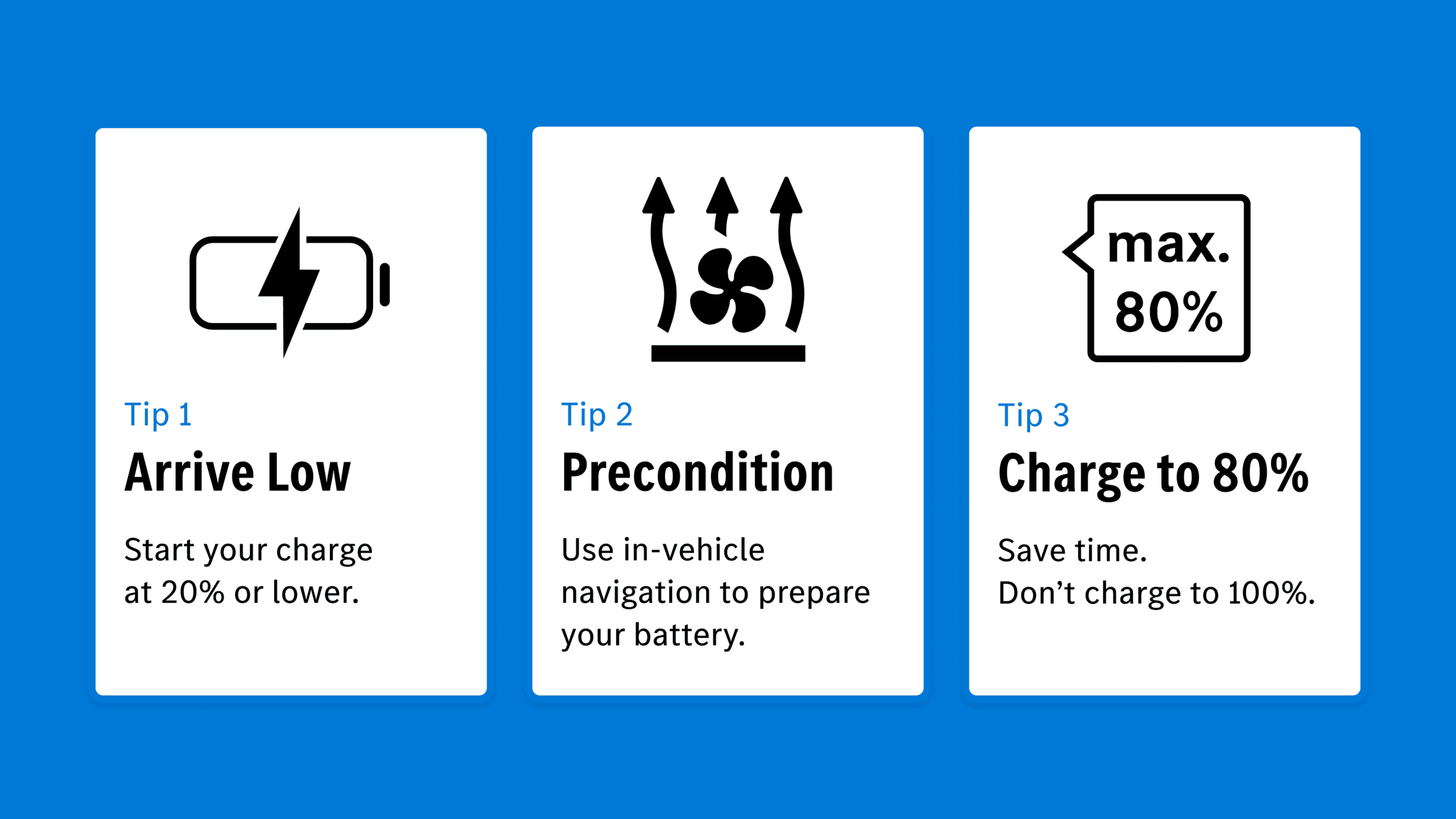
How to Precondition Your Battery3
- Use your vehicle’s built-in navigation to route to Mercedes-Benz High-Power Charging, as many vehicles use native navigation to automatically prepare the battery for fast charging. Some third-party navigation systems may not support this feature, so check your vehicle’s capabilities. You can also activate preconditioning manually if your vehicle allows (check your owner’s manual). This triggers step 2.
- Your vehicle will warm or cool the battery while you drive.
- The battery can then accept higher charging speeds when you arrive.
Preconditioning your battery is especially important during periods of extremely cold or hot weather. And Mercedes-Benz High-Power Charging also uses special technology like liquid-cooled cables to ensure your car can still request the maximum power even in hot conditions above 100° F. That means you can always get the speed you need to keep your day moving.
What Do EV Drivers Say About Mercedes-Benz High-Power Charging?
Here’s how high-power charging feels for customers: Drivers of all EV brands notice the speed and reliability of Mercedes-Benz High-Power Charging, based on real reviews from PlugShare.
“Excellent final session of our Thanksgiving trip. Cold temp but hit peak of 233kW after battery warmed up. 40kWh added in 15 minutes. Well-lit with security doing sweeps of the lot. Some dining spots open until 11:00 pm over weekends.”
—Hyundai Ioniq 5 driver
“Fastest charge ever seen. Over 200kW, but noticed after I reached 90% when charging severely slows, these were still doing 45kW at 94% when I stopped.”
—Kia EV6 driver
“Super great chargers. Only a 5-second handshake too! They delivered 150kW after a few seconds (which is the fastest my car can charge). I have never had such a quick charge session.”
—Volvo XC40 driver
“Great charging session and the first time I’ve hit the full 190kW max for my vehicle and held for longer than any I’ve ever seen.”
—Acura ZDX driver
“Peaked at 370kW. Very impressive.”
—GMC Sierra Denali EV driver
Find your nearest charger
Explore Mercedes-Benz High-Power Charging near you or along your route.
1Charging speed is dependent on vehicle, battery, and other conditions. Your actual results will vary based on several factors, including, but not limited to, selected model/trim characteristics and specifications (such as wheel/tire styles and pressure, vehicle features and systems, etc.), battery charge percentage, charger type, charging capacity settings, ambient temperature, battery temperature, age and condition, loading, weather, vehicle use and maintenance. This does not guarantee the availability, functionality, or accuracy of charging stations, nor does it account for potential charging station limitations or malfunctions. See your owner’s manual for charging setting details and guidelines.
2Power distribution varies based on vehicle demand and charging conditions. Speed levels depend on vehicle capability and other factors.
3Vehicle preconditioning depends on and may vary based on your vehicle. Please refer to your owner’s manual for detailed information specific to your vehicle on how to precondition your battery.